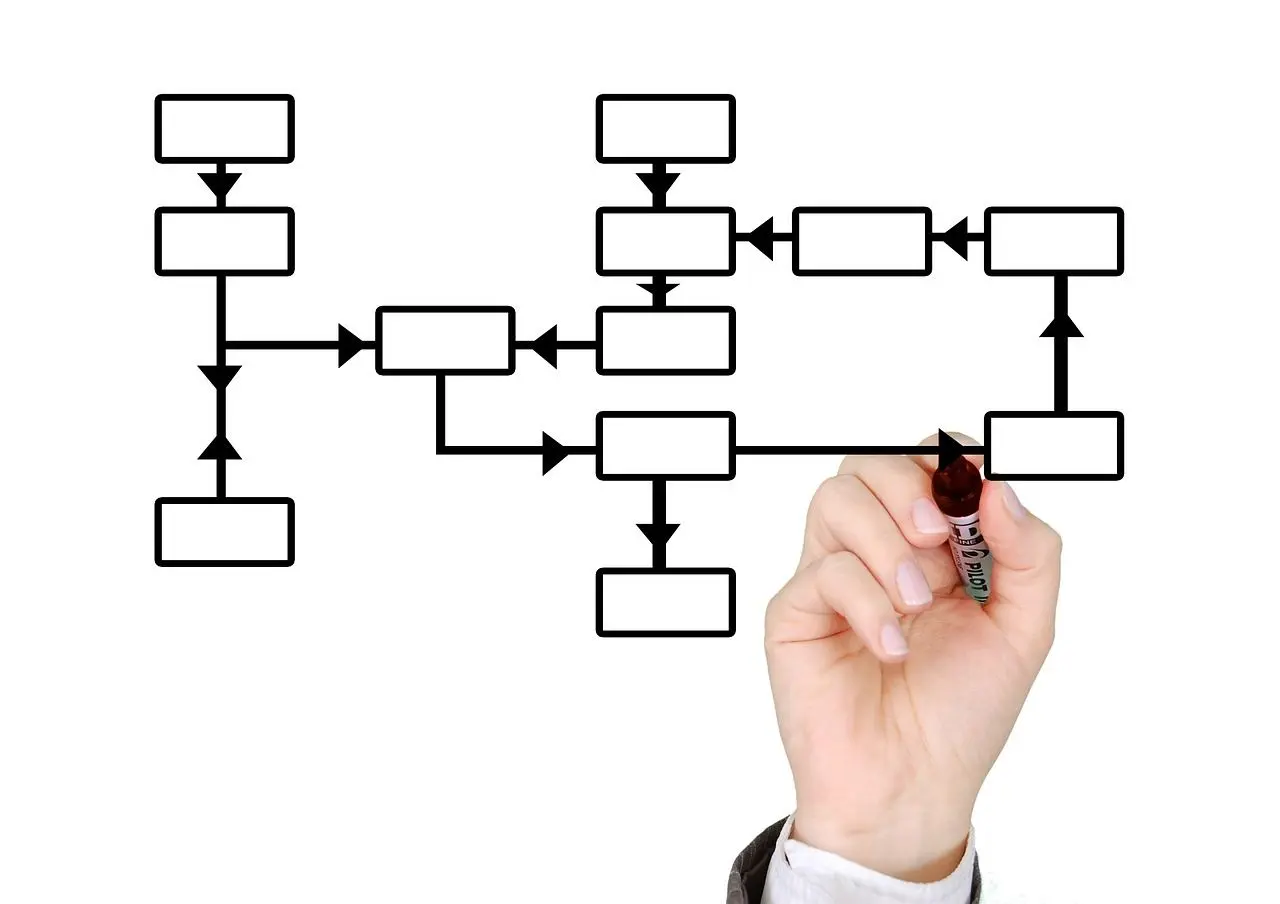

Not sure which organizational structure types fit your team? Most firms pick from functional, divisional, matrix, flat or network designs. Match the structure to how stable your work is and how much autonomy people need.
This guide is part of the wider topic of management consulting, where structure choices come up often.
| Item | Value |
|---|---|
| Examples of structures in Coursera’s overview | Seven structures |
| Core elements every structure defines | Four elements |
| Productivity gain Coursera links to effective communication | 55 percent |
| Employee satisfaction gain Coursera links to effective communication | 58 percent |
| Eras of structure evolution in OpenStax’s account | At least three eras |
| Structure types OpenStax discusses, with variations | Five types |
These figures come from Coursera’s guide to organizational structures and OpenStax’s Principles of Management chapter. Figures can change, so check the source before you rely on them.
What is an organizational structure?
Atlassian describes an organizational structure as a visual diagram of a company that shows what employees do, whom they report to, and how decisions are made. The diagram is only the picture. The real structure is the set of choices behind it.
Coursera says every structure settles four elements:
- Formalization: how comprehensive and clearly defined the rules and procedures are.
- Hierarchy: the number of management levels (the chain of command) and how many people report to each manager (the span of control).
- Centralization versus decentralization: whether most decisions sit with upper management or are shared across employees.
- Departmentalization: how jobs are grouped, whether by function, product, geography, process or customer.
The same page cites figures on effective communication: it can increase productivity by 55 percent and employee satisfaction by 58 percent, respectively, according to Coursera’s source. Treat those as the source’s claims rather than guarantees, since structure is only one lever among many (Coursera).
Mechanistic versus organic: the first choice
Before comparing named designs, OpenStax points out that early theorists sorted structures into two broad groups. Mechanistic structures are rule-based and top-down. Organic structures are the opposite.
- Mechanistic: supervisors have a narrow span of control, and the organization is governed by rigid departmentalization.
- Organic: structures are flatter, communication and decision-making flow in different directions, and there is a wider span of control.
The mechanistic form evolved in stable environments with low complexity, and OpenStax notes that the U.S. Postal Service and other manufacturing industries were historically mechanistic. Organic forms work best in unstable, complex, changing environments. In other words, the environment should drive the choice (OpenStax).
Both ends have a cost. Atlassian says a mechanistic model holds staff accountable but can hinder creativity and agility when the market shifts. An organic model can make the chain of command hard to decipher.
The common organizational structure types
Sources slice the list differently. The Virginia Tech strategic management text names four general types, Coursera lists seven examples, and OpenStax discusses five types with variations. The core designs overlap heavily.
- Functional: employees are divided into departments by functional area, such as marketing, production, human resources, information technology and customer service. Coursera credits it with clear reporting lines and defined career paths, but warns it may limit cross-functional communication.
- Divisional: employees are grouped by product areas and/or geographic regions, per Virginia Tech. Bryant University says it works well with multiple product lines or regions, while Coursera lists resource duplication and alignment challenges as risks.
- Matrix: a hybrid between functional and divisional structures, as the Virginia Tech text puts it.
- Flat: Mind Tools notes that smaller organizations tend to have flat structures that allow more flexibility.
- Boundaryless: flat, with decentralized decision making and many cross-functional teams, according to Virginia Tech.
Coursera also lists hierarchical, network and circular designs among its examples. OpenStax traces three eras, with the functional structure evolving first, followed by the divisional and then the matrix structure. Its third era added modular, team-based and virtual structures.

Mintzberg’s five configurations
Mind Tools explains that Mintzberg’s model defines five key structures. When strategy, environment and structure fit together well, they combine to create organizations that can perform well.
- Entrepreneurial (simple structure): a simple, flat structure, typical of start-ups and small businesses.
- Machine (machine bureaucracy): defined by standardization, and common in large manufacturers, government agencies and routine service firms.
- Professional: relies on highly trained professionals who demand control of their own work, as in schools, universities and law firms.
- Divisional (diversified): fits organizations with many product lines and business units.
- Innovative: also known as adhocracy.
Each one has a built-in weakness. As an organization grows, the entrepreneurial form may become inadequate because decision-makers become so overwhelmed that they start making bad decisions. In the professional form, authority is spread down the hierarchy, which limits the control senior executives can exercise (Mind Tools).
How do you pick the right structure?
The stakes are real: the Virginia Tech text warns that once a structure is created, it constrains future strategic moves. A design built to maximize efficiency may lack the flexibility to exploit new opportunities (Virginia Tech Libraries). Work through these steps before you redraw anything.
- Read your environment. Decide whether your market is stable and simple or unstable and complex, since structures are designed to fit external environments (OpenStax).
- Tie it to strategy. Ask what the design makes easy and what it makes slow, such as efficiency versus fast response to new opportunities.
- Check your size and growth. The more products you develop and people you hire, the harder it gets to lead without a clear diagram, says Atlassian.
- Weigh the trade-offs. Functional teams can limit cross-functional communication, while divisions can duplicate resources.
- Allow hybrids. Different units can use different designs when their conditions differ.
- Schedule a review. Mind Tools stresses reviewing and redesigning structures on an ongoing basis.
The people side matters too. Bryant University suggests that a more autocratic leadership style might suit a rigid hierarchy, while a transformational style might work in more fluid structures, so read up on leadership styles before you commit (Bryant University).
Finally, a redesign is a change effort, not just a new diagram. Plan it alongside the change management process you would use for any major shift in how people work.
Frequently asked questions
Which organizational structure types show up most often?
Show answer
Functional, divisional and matrix designs appear in both the Virginia Tech and Coursera lists. Flat, network and boundaryless designs are the newer, looser options.
Is a flat structure better than a hierarchy?
Show answer
Neither wins everywhere. A flat design buys speed and flexibility, but Atlassian warns the reporting lines can get murky, so it suits teams that tolerate ambiguity.
Can one company use several structures at once?
Show answer
Yes. Larger national and international corporations often blend designs, giving each unit the shape that suits its own conditions, according to OpenStax.
How often should you revisit your structure?
Show answer
Treat it as a living decision. Revisit it whenever your strategy, size or market shifts enough that the current design starts to slow people down.